Pattern sheets for artists
Date:
Fifteenth century?
Medium:
Paper
Dimensions:
Fol. 1: 8 × 29.8 cm; fol. 2: 22 × 31.7 cm
Description:
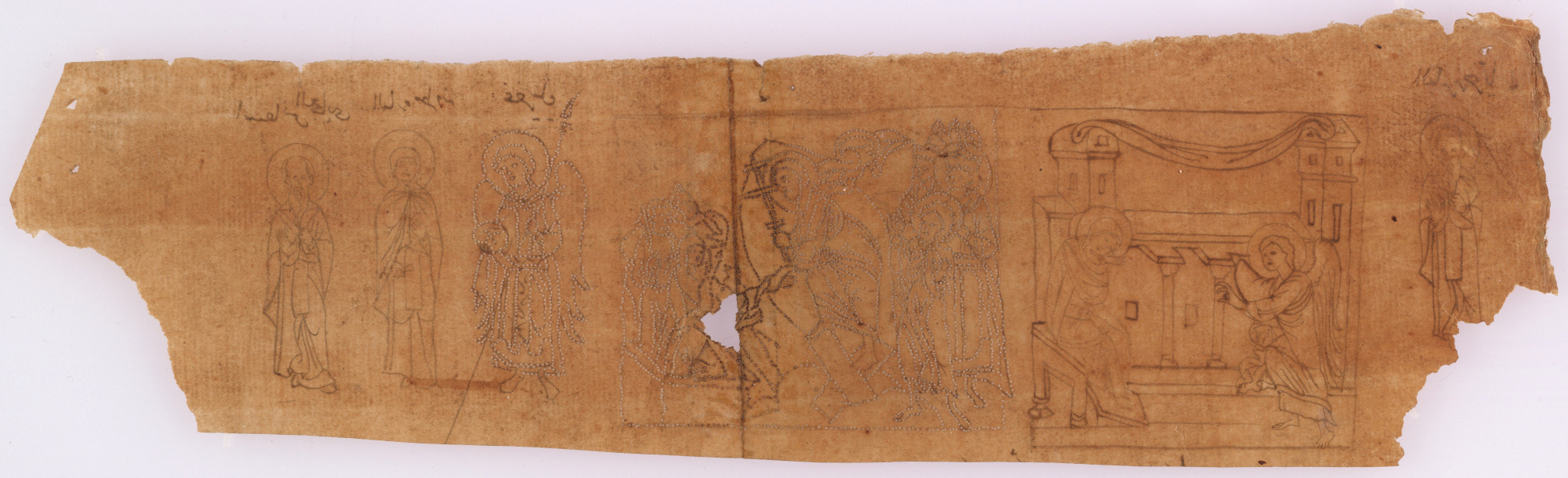
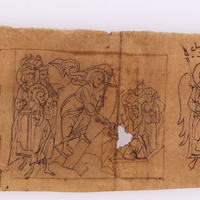
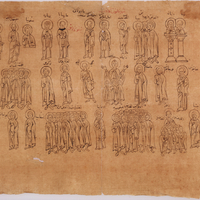
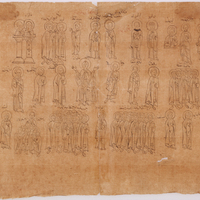
Medieval pattern sheets provided readymade models for artists to imitate. In Europe these sheets were often bound as books, sometimes with accompanying step-by-step instructions. The Islamicate world preserves a fifteenth- or sixteenth-century scroll with geometric patterns to be reproduced on walls and vaults (the Topkapı Scroll). From the Orthodox world, only two sheets of paper with patterns survive. On one page (fol. 1) are the archangel Gabriel, three saints, and framed scenes of the Annunciation and Anastasis. On the taller sheet (fol. 2) are haloed saints and Old Testament prophets, a total of thirty regularly spaced individuals or groups. On both sheets, the ink drawings on the recto bleed through to the verso of each sheet.
The choice of scenes and saints indicates that these sheets were used to produce books (such as menologia or lectionaries) or calendar icons for the Orthodox church. Fol. 1 has the Annunciation (feast day celebrated on 25 March) and a few of the saints commemorated in March. (The Anastasis, the Orthodox image of Christ's resurrection, is a movable feast tied to the date of Easter and not always in March.) Fol. 2 contains the whole calendar of Orthodox saints venerated in December. Most recognizable are the two stylite saints, Daniel and Luke, at the right end of the top row (feast day 11 December). In the middle of the second row, the Old Testament prophet Daniel stands in the orant pose behind three Hebrew children who were cast into a furnace for refusing to venerate the Babylonian king (17 December). All the figures, but not the scenes, are labeled in Arabic, in a script dated between the thirteenth and fifteenth centuries. The artists therefore worked for Orthodox patrons in an Arabic-language environment, possibly in Egypt; the faith of the artists is unknown.
The Anastasis and the angel next to it have been pricked with tiny holes to make the page into a kind of tracing paper. In a process called pouncing, finely ground charcoal would be sprinkled on the pricked image to transfer its outline to a piece of paper underneath. In this way, artists could reproduce a model with great fidelity, and even a poor artist could do a fine copying job. Despite this evidence for potential pouncing, the pricking was incomplete—Gabriel's feet and the upper right corner of the Anastasios have no holes—and there are no traces of charcoal on the paper sheets.
Relevant Textbook Chapter(s):
10,
11
Repository and Online Resources:
• Read more about these pattern sheets on the Beinecke Library website.
• Read more about model books on the Khan Academy website.
Image Credits:
Yale University Library
Tags:
Byzantine,
Byzantine,
Islamicate,
Access to the sacred,
Artistic production,
Arabic ,
Bible,
Saints