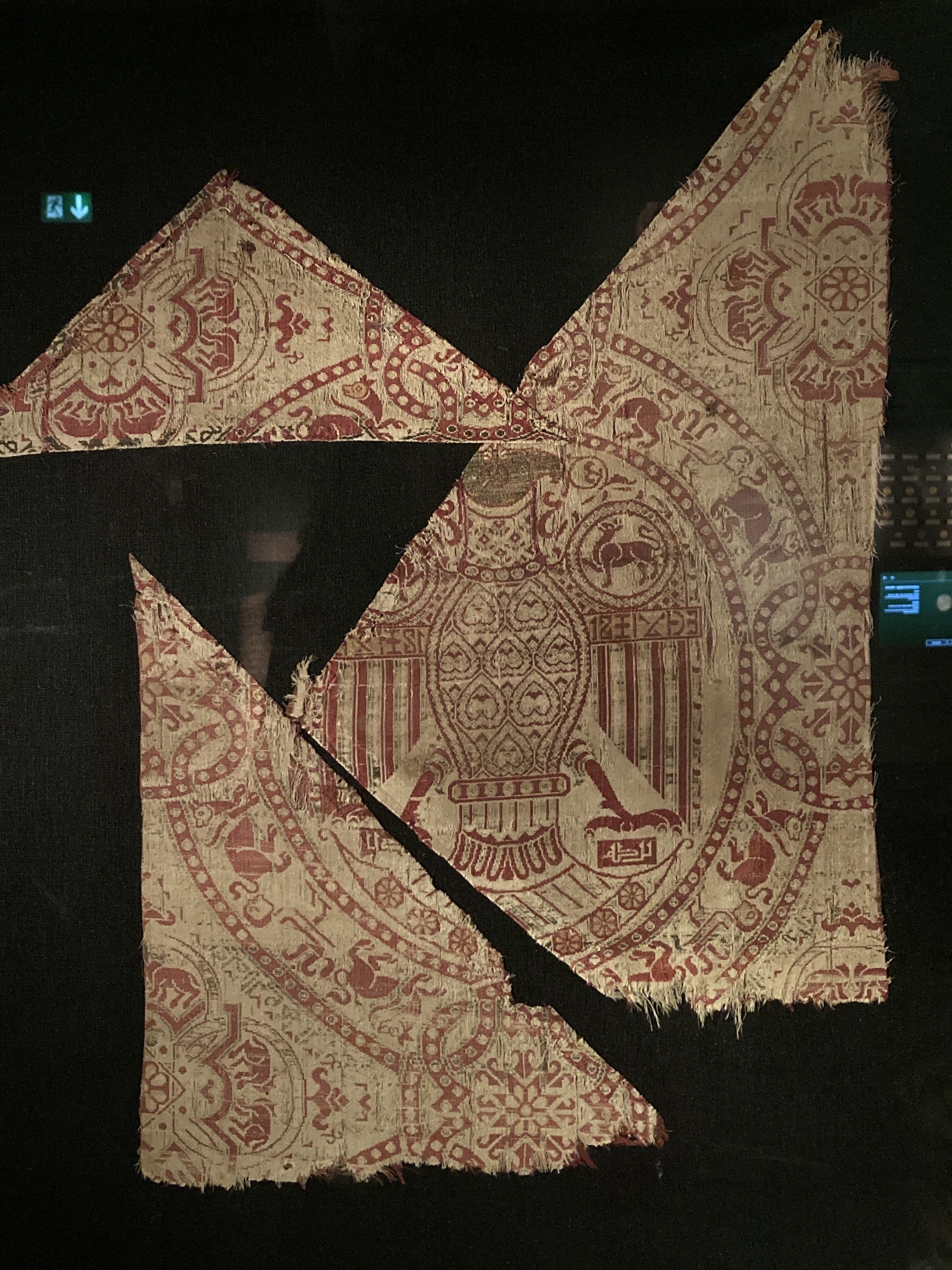
Almoravid eagle textile
Type:
Textiles
Date:
first half of twelfth century
Location or Findspot (Modern-Day Country):
Spain
Medium:
Silk,
Silver or gold thread
Description:
This fragmentary textile made in Spain, possibly in Almería (in al-Andalus), bears the name of the fifth Almoravid emir, Ali ibn Yusuf (r. 1106–43), who commissioned the minbar of the Kutubiyya mosque. During his reign the Almoravids besieged several Christian capitals in the Iberian peninsula. The lampas-weave silk, woven on a loom with raised gold thread, features an eagle, its body covered with stylized ornamental patterns that include a griffin in a medallion and a pseudo-Latin inscription band. Under its claws is the word baraka, Arabic for "blessing." The surrounding interlace band contains more fantastic creatures and traces of a Kufic inscription that says "Blessing from God and victory, support, and long life."
Precious Islamicate textiles were often reused in Christian contexts. These fragments were found inside a reliquary of St. Librada that was donated to the cathedral of Sigüenza in 1147 by King Alfonso VII of Castile and Léon. Alfonso may have acquired the textile when he sacked Almería in 1147. These fragments are in the Danish National Museum, Copenhagen (9/2001); other pieces from the same reliquary are now dispersed in museums in the USA and Europe.
Precious Islamicate textiles were often reused in Christian contexts. These fragments were found inside a reliquary of St. Librada that was donated to the cathedral of Sigüenza in 1147 by King Alfonso VII of Castile and Léon. Alfonso may have acquired the textile when he sacked Almería in 1147. These fragments are in the Danish National Museum, Copenhagen (9/2001); other pieces from the same reliquary are now dispersed in museums in the USA and Europe.
Relevant Textbook Chapter(s):
7
Repository and Online Resources:
• Another piece of this textile is in the Museum of Fine Arts, Boston.
• Another piece of this textile is in the Metropolitan Museum of Art, New York.
Image Credits:
Linda Safran