Svetitskhoveli Cathedral
Type:
Churches
Date:
1010–29
Location or Findspot (Modern-Day Country):
Georgia
Description:
Medieval Georgian chronicles say that the chiton (robe) of Christ was buried in Mtskheta, brought there by Jews driven out of Jerusalem in the first century CE. In the early fourth century, the future St. Nino went from Jerusalem to Georgia (then known as Iberia), where she had close relations with local Jews. She converted them to Christianity, along with King Mirian III (r. 284–361), which led to the conversion of his mostly Zoroastrian subjects. Mirian erected monumental crosses across the kingdom, including one overlooking Mtskheta, the ancient Iberian capital. The cross was enclosed in a canopy and later (ca. 600) in a domed tetraconch church, called Jvari (Cross).
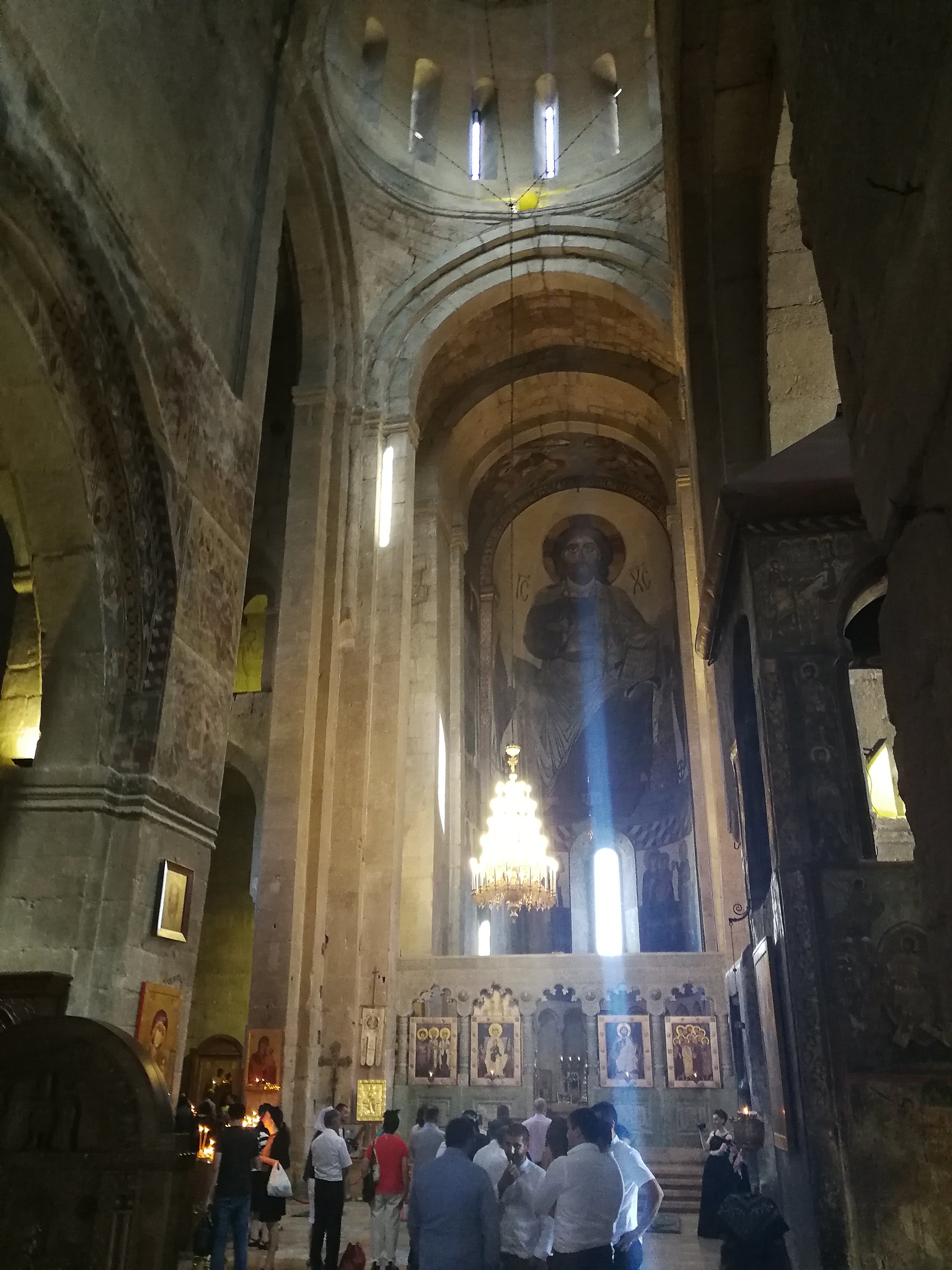
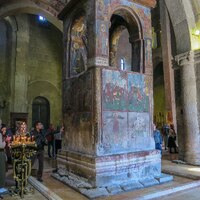
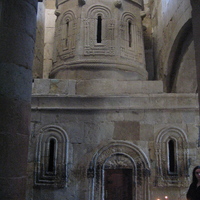
The Svetitskhoveli Cathedral in Mtskheta was originally called the Holy of Holies and later Great Zion; instead of housing the Ark of the Covenant, like the biblical Holy of Holies in the Temple in Jerusalem, it held the robe of Christ. Svetitskhoveli means "Life-Giving Pillar," commemorating the site where St. Nino successfully prayed for a pillar to be erected after workmen failed to do so. The painted pillar-tower now enshrined in the nave marks that site, but dates to the fifteenth century (with paintings dated 1688). The pillar miraculously exuded myron. Also inside, near the west end of the south wall, is a domed replica of the tomb of Christ in the Holy Sepulcher in Jerusalem (fifteenth century).
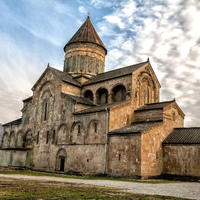
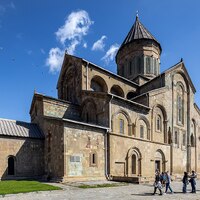
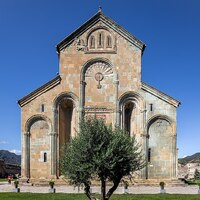
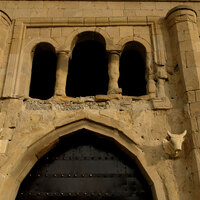
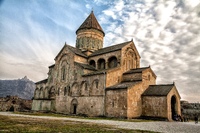
The fourth-century wooden cathedral was rebuilt by 500 as a three-aisle stone basilica with four pairs of cruciform piers. Rebuilt again between 1010 and 1029 by the master builder Arsukidze for the Georgian patriarch (catholicos) Melkisedek I, Svetitskhoveli was medieval Georgia's largest cathedral and the burial place of its rulers and religious leaders. The eleventh-century stone church has an elongated three-aisle plan with a conical dome at the crossing. The facades are articulated with blind arches and relief sculpture. It was severely damaged in 1400 by the Timurids, after which the west end was elongated, but the facades retain a considerable quantity of medieval sculpture.
With its relics, crosses, buildings, and liturgies, Mtskheta was meant to be a new Jerusalem, with Svetitskhoveli Cathedral, housing the robe of Christ, equivalent to the Holy Sepulcher and Jvari connected to Calvary. Many other medieval churches in and around Mtskheta were named for sites in the Holy Land.
The Svetitskhoveli Cathedral in Mtskheta was originally called the Holy of Holies and later Great Zion; instead of housing the Ark of the Covenant, like the biblical Holy of Holies in the Temple in Jerusalem, it held the robe of Christ. Svetitskhoveli means "Life-Giving Pillar," commemorating the site where St. Nino successfully prayed for a pillar to be erected after workmen failed to do so. The painted pillar-tower now enshrined in the nave marks that site, but dates to the fifteenth century (with paintings dated 1688). The pillar miraculously exuded myron. Also inside, near the west end of the south wall, is a domed replica of the tomb of Christ in the Holy Sepulcher in Jerusalem (fifteenth century).
The fourth-century wooden cathedral was rebuilt by 500 as a three-aisle stone basilica with four pairs of cruciform piers. Rebuilt again between 1010 and 1029 by the master builder Arsukidze for the Georgian patriarch (catholicos) Melkisedek I, Svetitskhoveli was medieval Georgia's largest cathedral and the burial place of its rulers and religious leaders. The eleventh-century stone church has an elongated three-aisle plan with a conical dome at the crossing. The facades are articulated with blind arches and relief sculpture. It was severely damaged in 1400 by the Timurids, after which the west end was elongated, but the facades retain a considerable quantity of medieval sculpture.
With its relics, crosses, buildings, and liturgies, Mtskheta was meant to be a new Jerusalem, with Svetitskhoveli Cathedral, housing the robe of Christ, equivalent to the Holy Sepulcher and Jvari connected to Calvary. Many other medieval churches in and around Mtskheta were named for sites in the Holy Land.
Relevant Textbook Chapter(s):
2,
6
Repository and Online Resources:
• See an interactive plan of the cathedral, plus more photos, on the Crossing Frontiers website.
Image Credits:
Wikimedia Commons; Flickr