Ingå (Inkoo) church
Type:
Churches,
Wall paintings
Date:
ca. 1510
Location or Findspot (Modern-Day Country):
Finland
Description:
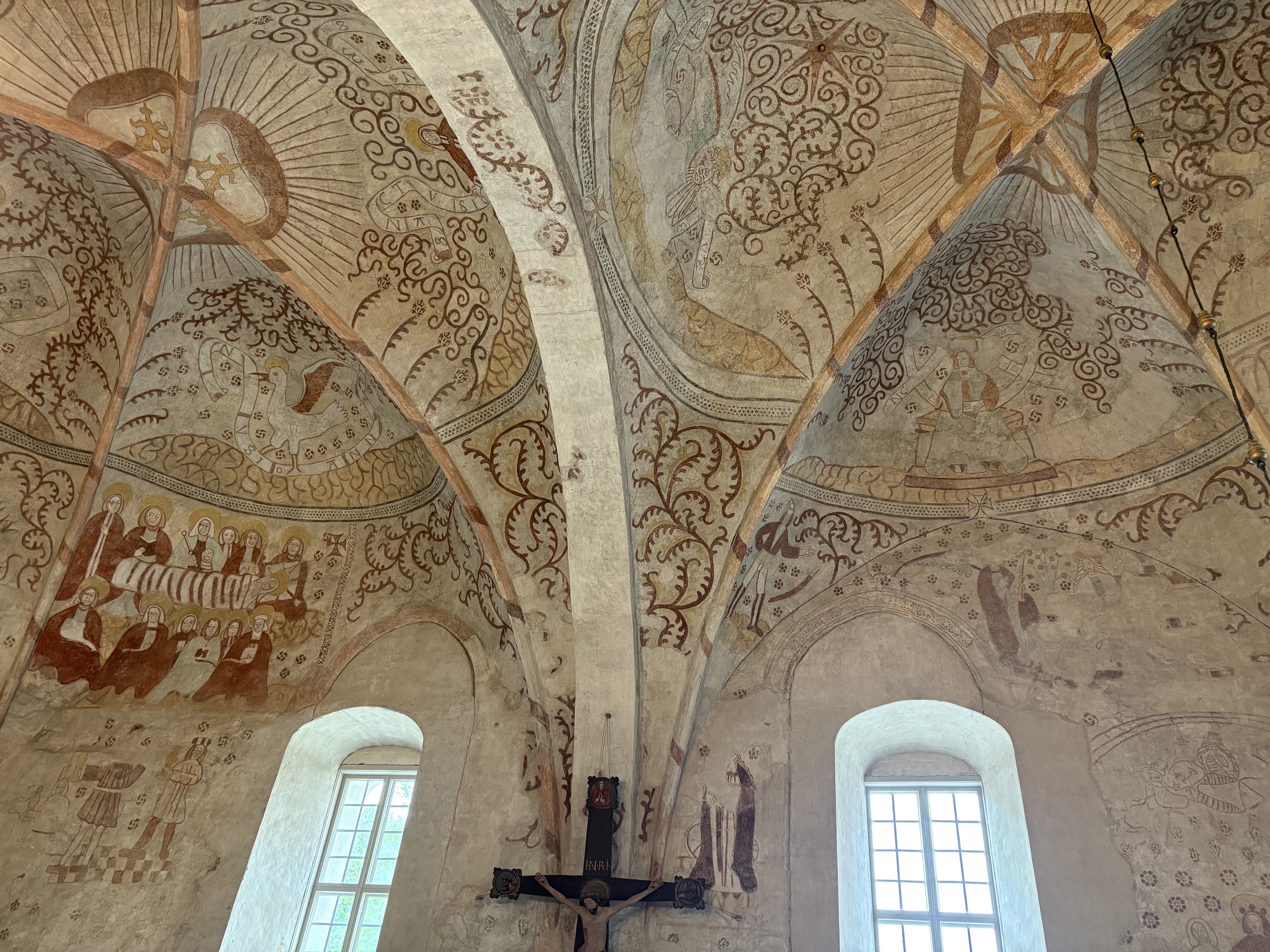
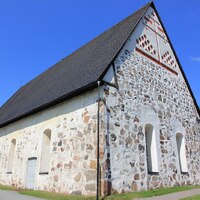
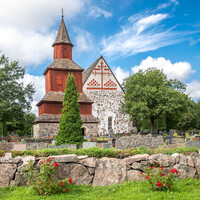
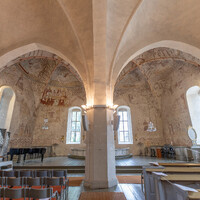
Ingå (Inkoo), on the southern coast of Finland, boasts a large fieldstone church dedicated to St. Nicholas, patron saint of seafarers. Built between 1430 and 1510, the two-aisle, rib-vaulted church has paintings of Old and New Testament scenes in the sanctuary vaults. Invaders from Denmark damaged the church in 1509, so the wall paintings may date after that. The wooden bell tower was added in the eighteenth century.
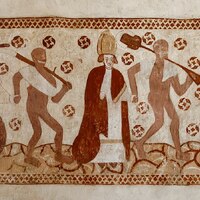
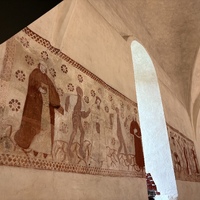
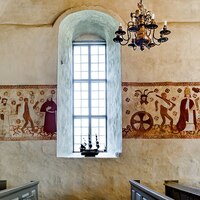
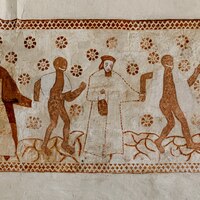
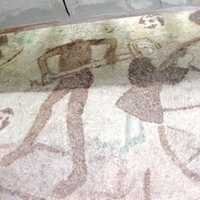
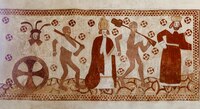
The north wall of the church was painted with a Dance of Death frieze (a window inserted in 1820 destroyed some of the painting). It shows grinning corpses—personfications of Death—dancing with figures who include (starting at the beginning of the procession, on the right) a crowned king, a miter-wearing bishop, a nobleman with a feathered headdress, an official, a merchant, a Dominican monk, and a figure who is probably a woman. Their left-to-right movement, toward the church sanctuary, is unusual: most scenes of people dancing with death move left, away from the altar and toward damnation. The pope is often included the scene, but in the far North he was usually omitted in favor of a local bishop, who had a greater impact on people's lives than the faraway pope in Rome.
The earliest monumental Dance of Death originated in a Paris cemetery in 1425 and spread widely thereafter, especially in northern Europe. Finland in the early sixteenth century was part of the kingdom of Sweden, which lacks this iconography, so the artists at Inkoo were likely inspired by models from Estonia; the Hanseatic trading city of Tallinn is just across the Finnish Gulf. Like scenes of the Last Judgment, representations of the Dance of Death warned the living about the perils of sinful behavior. They may also have had an apotropaic function, to keep away disease. It is not possible to connect the Ingå images with a specific outbreak, but nearby Tallinn suffered from bubonic plague between 1504 and 1510. Images of saints thought to protect against the plague proliferated in late medieval Scandinavia, including—at Ingå—St. Roch, whose name was linked with the Finnish word for pox, rokko.
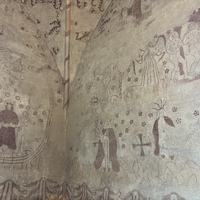
To the west of the Dance of Death are more reminders of unpredictable mortality: men rising and falling on a Wheel of Fortune and a man perched in a tree, unaware that Death is sawing the trunk below him.
The north wall of the church was painted with a Dance of Death frieze (a window inserted in 1820 destroyed some of the painting). It shows grinning corpses—personfications of Death—dancing with figures who include (starting at the beginning of the procession, on the right) a crowned king, a miter-wearing bishop, a nobleman with a feathered headdress, an official, a merchant, a Dominican monk, and a figure who is probably a woman. Their left-to-right movement, toward the church sanctuary, is unusual: most scenes of people dancing with death move left, away from the altar and toward damnation. The pope is often included the scene, but in the far North he was usually omitted in favor of a local bishop, who had a greater impact on people's lives than the faraway pope in Rome.
The earliest monumental Dance of Death originated in a Paris cemetery in 1425 and spread widely thereafter, especially in northern Europe. Finland in the early sixteenth century was part of the kingdom of Sweden, which lacks this iconography, so the artists at Inkoo were likely inspired by models from Estonia; the Hanseatic trading city of Tallinn is just across the Finnish Gulf. Like scenes of the Last Judgment, representations of the Dance of Death warned the living about the perils of sinful behavior. They may also have had an apotropaic function, to keep away disease. It is not possible to connect the Ingå images with a specific outbreak, but nearby Tallinn suffered from bubonic plague between 1504 and 1510. Images of saints thought to protect against the plague proliferated in late medieval Scandinavia, including—at Ingå—St. Roch, whose name was linked with the Finnish word for pox, rokko.
To the west of the Dance of Death are more reminders of unpredictable mortality: men rising and falling on a Wheel of Fortune and a man perched in a tree, unaware that Death is sawing the trunk below him.
Relevant Textbook Chapter(s):
11