Mshatta
Type:
Palace complexes
Date:
743–44
Location or Findspot (Modern-Day Country):
Jordan
Description:
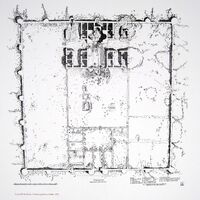
Mshatta was one of about thirty "desert palaces" (qasrs) built for Umayyad rulers in the Bilad al-Sham, roughly the area of Syria and Jordan. The name means "Winter Palace." It was erected for Caliph al-Walid II (r. 743–44); it remained unfinished after he was assassinated, and later it sustained significant damage from an earthquake. The palace contained an entrance complex with a mosque, a courtyard, a throne-room complex, and living quarters, all enclosed in a 144-meter-long perimeter wall. One large ceremonial space is a basilica terminating in a domed triconch. The use of ashlar masonry and brick continued the building traditions of early Byzantine Syria.
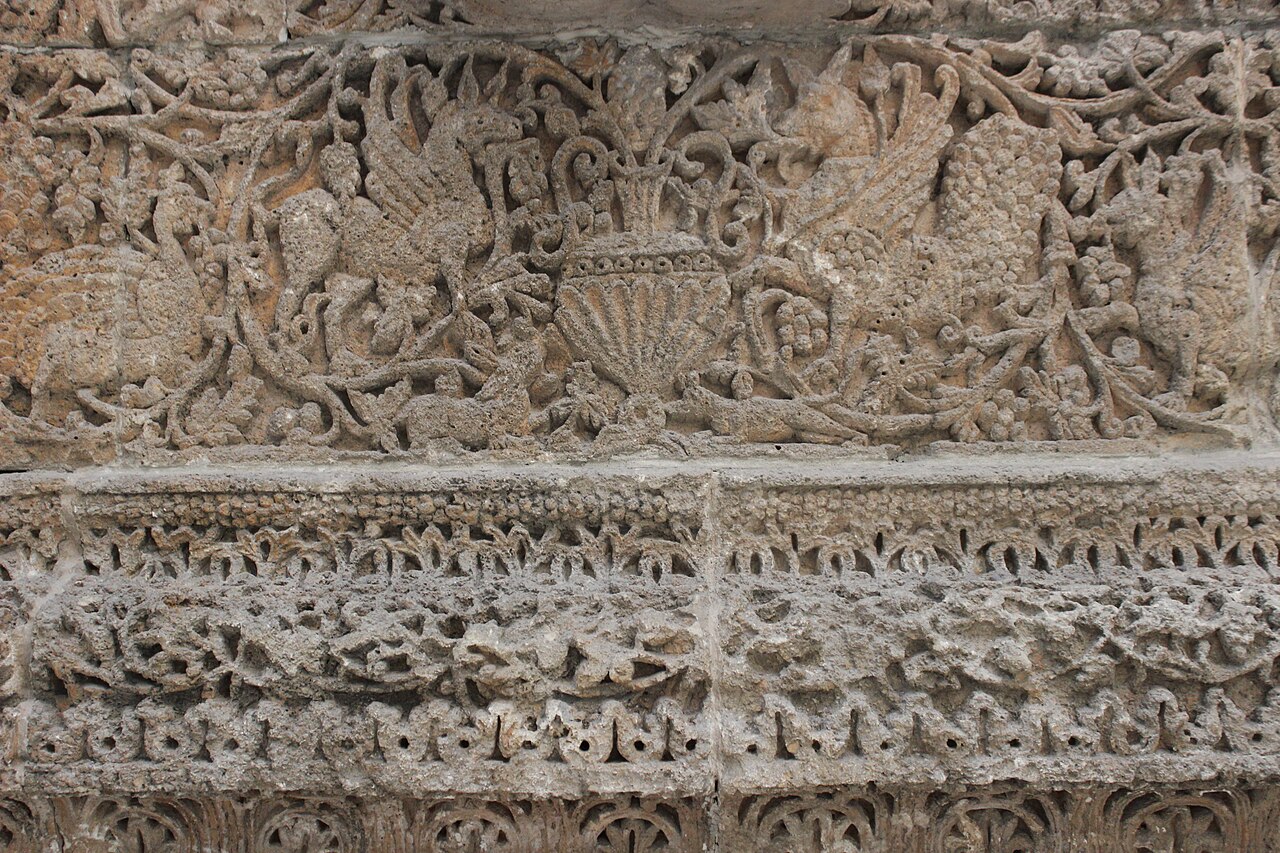
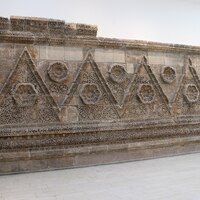
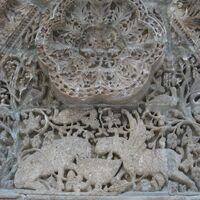
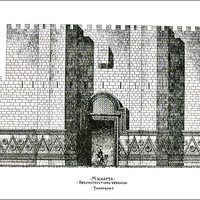
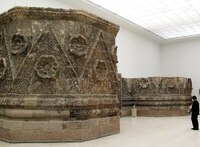
The south (entrance) facade—33 m long and 5 m high—is deeply carved with stone triangles enclosing large rosettes, grapevines, animals, and geometric motifs. The effect is like filigree, balancing naturalistic and stylized features and completely covering the wall surface. The vines, vases, griffins and lions derive from Roman art, but the griffin here faces a simurgh (or senmurv), a lion-headed Persian bird drawn from the Zoroastrian repertoire (one of the ambassadors depicted at Afrasiab wears a garment decorated with simurghs). Many of the carved panels on the left side of the entrance include animals and composite creatures, but those on the right do not, possibly because the mosque was behind the wall on this side. Islam prohibits the representation of living creatures inside a mosque, not outside it.
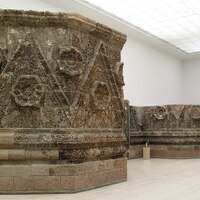
Part of the facade was moved to Berlin in 1903, a gift from the Ottoman sultan to the German emperor. At the time, the Turks did not know that Mshatta was an Islamic building; because of the fine stone carving and absence of Arabic inscriptions, they thought it was Byzantine.
Relevant Textbook Chapter(s):
4
Repository and Online Resources:
• The south facade is in the Museum für Islamische Kunst, Berlin (no. I. 6163).
• Watch a short video about Mshatta here.
Image Credits:
Wikimedia Commons