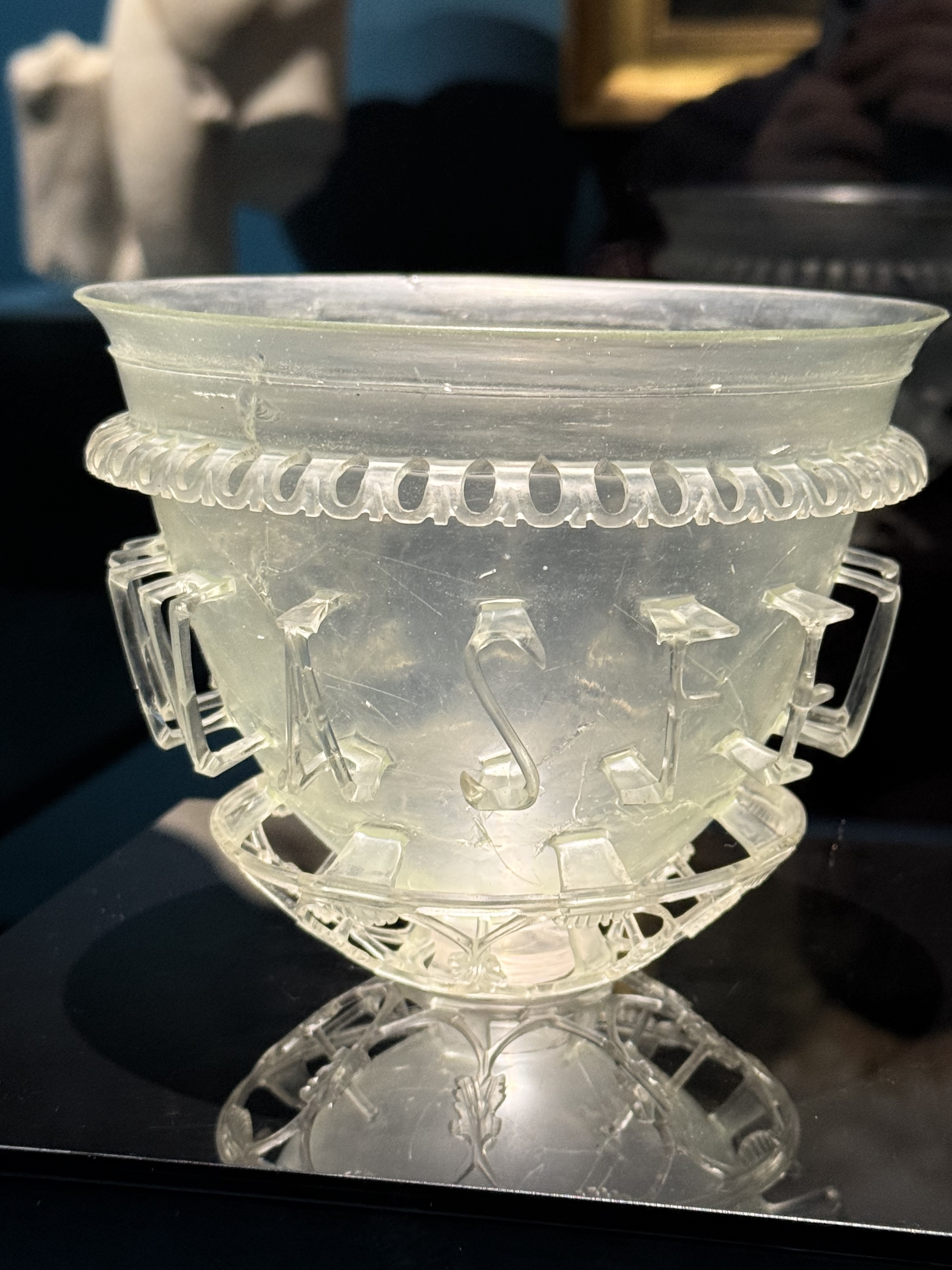
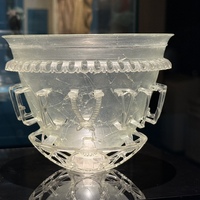
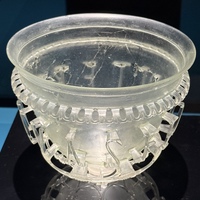
Glass cage-cup from Autun
Type:
Vases,
Grave goods
Date:
Late fourth century
Location or Findspot (Modern-Day Country):
France
Medium:
Glass
Dimensions:
H 12.6 × W 15 cm
Description:
In 2020, an exceptional fourth-century glass cup was discovered in fragments in a stone sarcophagus outside an early Christian church in Autun. The cemetery, which contained both lead and stone coffins, was in use from the third to the fifth century, but most of the graves date to the fourth. Texts indicate that the early bishops of Autun were buried here, but so were non-Christians. The vase was placed at the foot of the sarcophagus's occupant, whose faith is unknown.
This type of luxury glassware is called a cage cup (Latin vas diatretum, pl. diatreta) because the outer "cage" of decoration projects from the smooth body of the cup underneath. The cup—possibly made in the Rhineland—was made by first blowing and then carving. Below a frieze of egg-shaped motifs, an inscription in Latin exhorts the owner to "VIVAS FELICITER" (Live in happiness). Such a large inscription in such high relief has few parallels. Inside the vase were residues of oil, plants, flowers, and ambergris, a fragrant substance derived from the intestine of sperm whales that washes up on beaches. This is the earliest known use of ambergris; previously it was attested only beginning in the sixth century as an ingredient in nard, a perfume made for the Church.
Found outside St-Pierre-l'Estrier, Autun, tomb 46; now in the Musée Rolin, Autun.
Relevant Textbook Chapter(s):
2
Image Credits:
Linda Safran