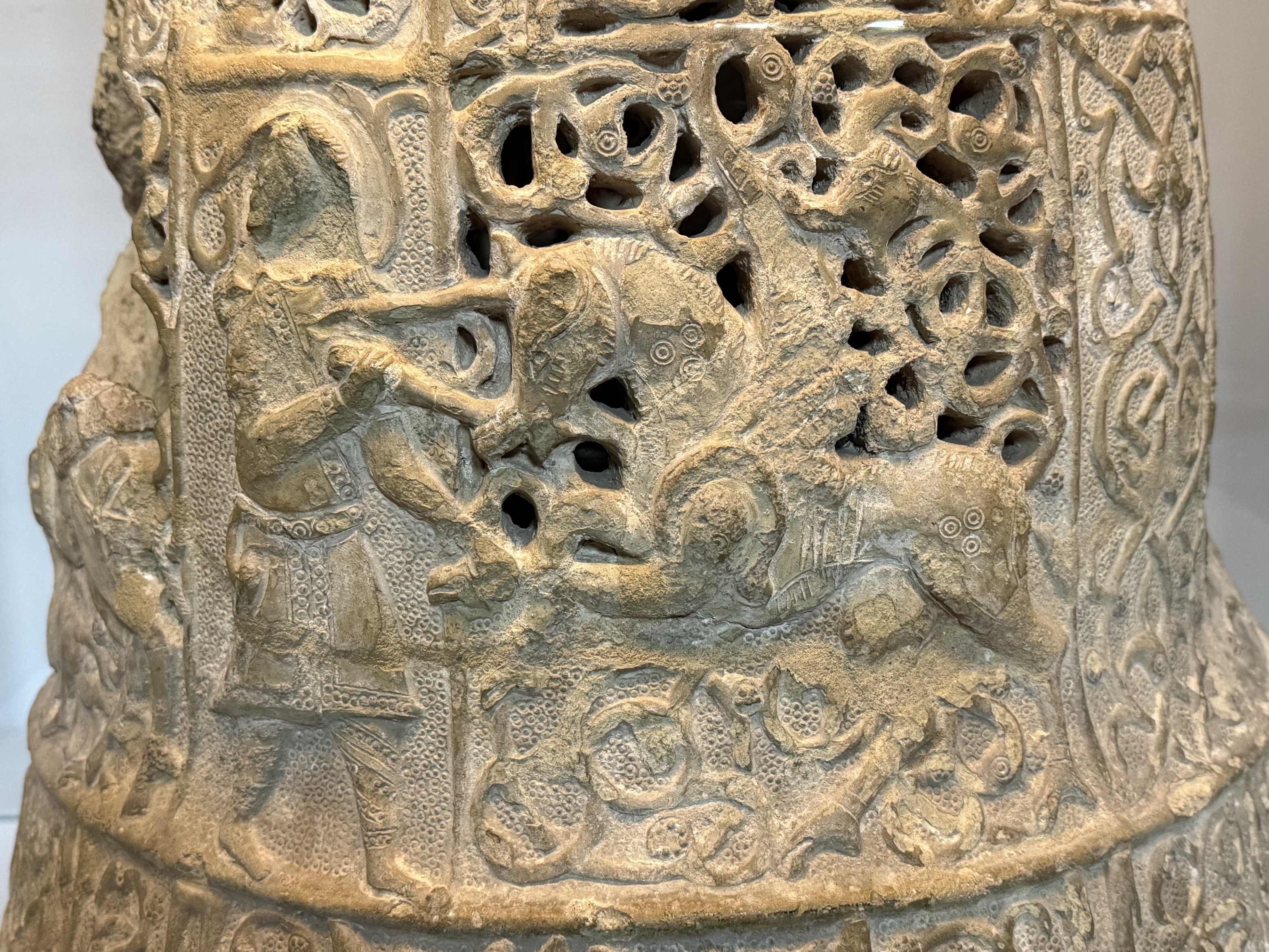
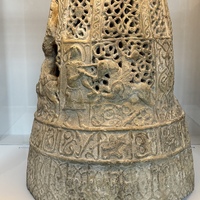
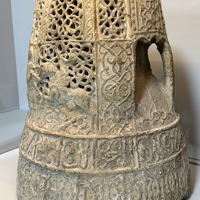
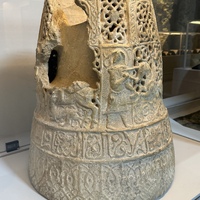
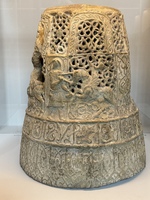
Ceramic jar with unicorns
Type:
Ceramics
Date:
first half of the thirteenth century
Location or Findspot (Modern-Day Country):
Iraq
Medium:
Earthenware
Dimensions:
63 × max. 54.5 cm
Description:
This double-walled, unglazed clay jar was made in Iraq in the first half of the thirteenth century; only the neck is preserved today. It is richly decorated with openwork and applied interlace and foliage motifs, as well as figural images: a horseman subduing a lion (partly destroyed) is flanked by two panels in which an armed man fights a unicorn. The Islamicate unicorn (Arabic karkadann) was usually winged, as here, and these have the hind legs of a bird of prey and a curly tail that ends in a dragon's head (almost hidden in the interlace). Such great heroes as Alexander (Iskander) and Bahram Gur engaged in successful combat against unicorns, but it is not possible, or necessary, to identify a specific event or protagonist here. Unicorn iconography was very popular across different cultural groups in western Asia and Europe, especially after the twelfth century, and it decorated works in all media.
The dedicatory inscription in Arabic along the lower rim invokes generic good wishes for the owner: "enduring strength, general well-being, a well-protected life." The jar probably held water in a prosperous household. The double-wall technique was practical: the inner clay core is solid, but tiny amounts of water would still seep into the space between the two walls and then evaporate through the openwork panels in the outer shell, drawing heat from the vessel and cooling the remaining water. This process, called micro-evaporation, is still used today.
The dedicatory inscription in Arabic along the lower rim invokes generic good wishes for the owner: "enduring strength, general well-being, a well-protected life." The jar probably held water in a prosperous household. The double-wall technique was practical: the inner clay core is solid, but tiny amounts of water would still seep into the space between the two walls and then evaporate through the openwork panels in the outer shell, drawing heat from the vessel and cooling the remaining water. This process, called micro-evaporation, is still used today.
Relevant Textbook Chapter(s):
8
Repository and Online Resources:
• Zoom in on the unicorn jar on the website of the Museum für Islamische Kunst, Staatliche Museen zu Berlin (inv. no. I. 5533).
Image Credits:
Linda Safran