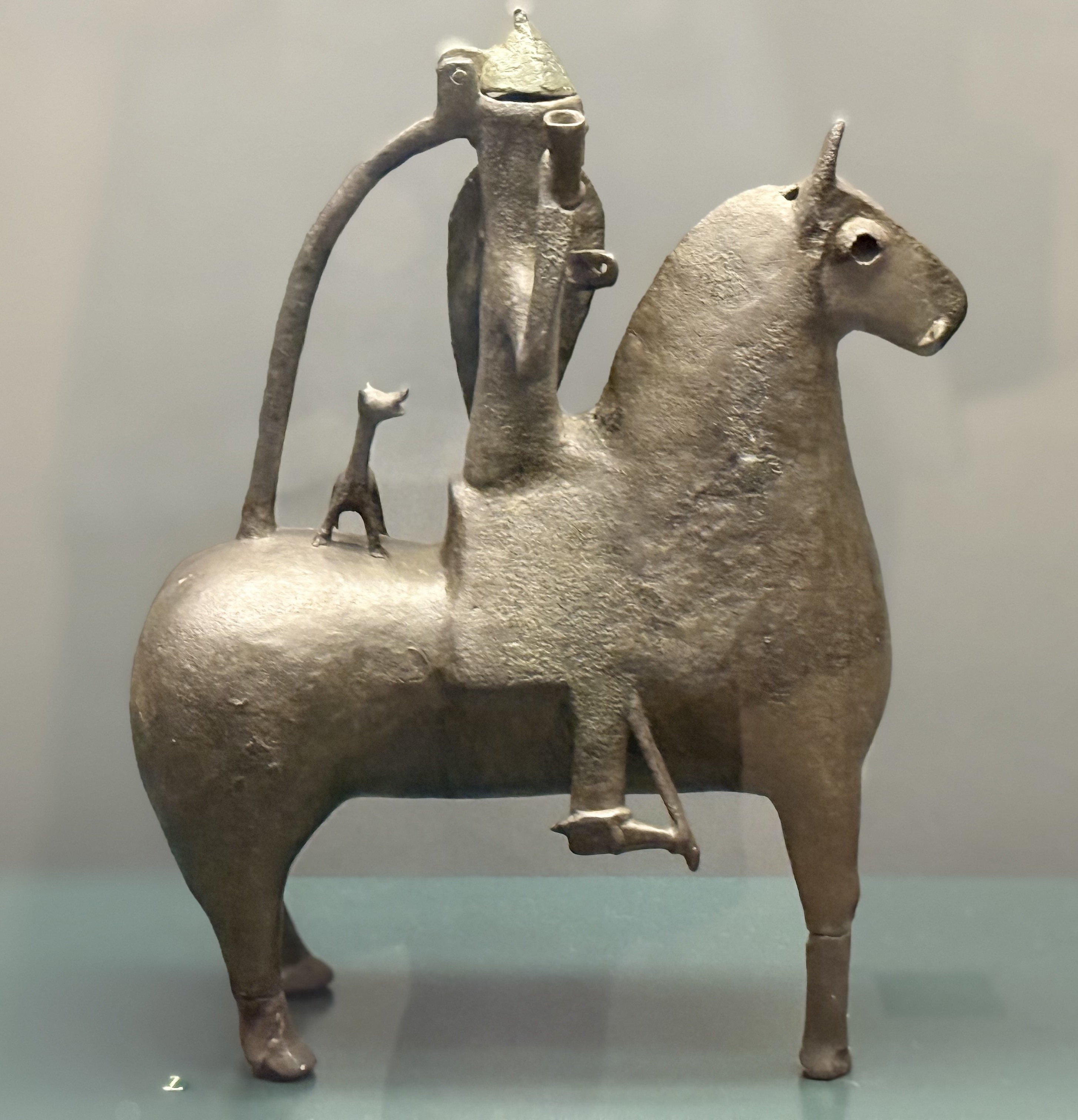
Hunter with cheetah aquamanile
Type:
Sculptures
Date:
Second half of the twelfth century
Location or Findspot (Modern-Day Country):
Romania
Medium:
Bronze
Dimensions:
H 30.7 cm
Description:
Approximately four hundred medieval aquamanilia are preserved today, many in east-central Europe. The ones used for elite handwashing often reference aristocratic or royal activities, including horseback riding or hunting. In this example, the rider holds a hunting horn to his lips and carries a shield. That he is a hunter is evident from the small creature who perches on the back of the horse: it is a slender cheetah, trained to leap from the horse to chase prey (hares or small deer). Hunting with famously swift cheetahs was done in China, India, and Islamicate lands before it was adopted by Byzantine and European courts by the twelfth century. The practice ended in Europe in the seventeenth century.
The aquamanile was filled via the hunter's pyramid-shaped helmet, which opens on a hinge, and poured out through the horse's mouth. The cast vessel has thin walls, and the left side of the horse (including its front left leg) has broken away. The horse's eyes may once have been inlaid in a different material.
The aquamanile was found in Kisjenö, Hungary (now Chişineu-Criş, Romania). It is now in the Magyar Nemzeti Múzeum (Hungarian National Museum), Budapest, inv. no. 1909.76.
Relevant Textbook Chapter(s):
7,
8
Image Credits:
Linda Safran